Awwwards
404media is now part of Awwwards. Find our studio profile and work there.
(Announcement)
W.
404media is now part of Awwwards. Find our studio profile and work there.
We launched the new HBE Healthcare website.
We launched the new Property Partners website.

A practice website in Austria has two jobs: help patients book in a few clicks and stay within the Ärztegesetz. Here is what that means in practice, with examples from our health projects.
 Christoph SpeiserProject lead & sales
Short answer: A good website for doctors in Austria answers five questions in under ten seconds (what you treat, which insurance funds you have contracts with, opening hours, where you are and how to book) and stays within § 53 Ärztegesetz: factual, true information is allowed, pushy self-promotion is not. Add GDPR-compliant online booking, a maintained Google Business Profile and local SEO, and the site works as your second front desk.
Most practice websites in Austria were built once and then forgotten: a photo of the team, a list of services in medical jargon, a phone number that is busy in the morning. Patients today compare on their phones, often late in the evening, and they book where it is easiest.
We have built websites for psychologists, therapists and health companies, from Christina Pedretscher in Carinthia to HBE Healthcare and Blue & Green Healthcare. This guide sums up what we have learned, plus the legal points you need to know as a doctor in Austria. It is not legal advice; for borderline cases ask your regional Medical Chamber.
Patients don’t visit a practice website to be impressed. They come with a concrete question, and every second spent searching costs trust. In our projects these are the questions that come first:
For Julia-Susanna Mende we sorted the services for children, teenagers and adults so that every visitor lands on the page meant for them (case study). For Christina Pedretscher the brief was to make the path “from first orientation to booking an appointment as clear as possible”, with a calm design that builds trust before the first conversation.

The legal basis is § 53 Ärztegesetz. It forbids doctors from publishing information that is unfactual, untrue or damaging to the profession’s reputation. The Austrian Medical Chamber spells this out in its advertising guideline “Arzt und Öffentlichkeit”, which explicitly allows doctors to run their own website. What counts is how you present yourself.
| Generally fine | Not allowed or risky |
|---|---|
| Factual information on services, methods and equipment | Pushy or “marketing” self-promotion (“Vienna’s best surgeon”) |
| Training, diplomas and focus areas you actually hold | Claims of medical exclusivity that are not true |
| Insurance contracts, opening hours, languages spoken | Advertising for medicines, medical devices or manufacturers |
| Prices or price ranges for private services | Before/after images for aesthetic procedures (§ 8 ÄsthOpG) |
| Real photos of the team and the rooms | Comparisons that suggest you are better than colleagues |
Testimonials and patient quotes are a grey area: depending on how they are used, they can be read as self-promotion. Linking to your Google reviews is common practice; curated quotes on your own site should be cleared with the Chamber first. And when replying to Google reviews, remember professional secrecy (§ 54 ÄrzteG): never confirm that someone is your patient or discuss treatment details.
The imprint is mandatory too: name, address, contact details, Medical Chamber membership, professional title and the country that granted it, a reference to the Ärztegesetz and, if applicable, the VAT number. Missing information under the E-Commerce Act (ECG) can be fined up to €3,000.
As soon as patients send you data through your website, you are processing health data in many cases. Even the fact that someone books with a psychotherapist or cardiologist reveals something about their health, which makes it special-category data under Art. 9 GDPR. That doesn’t make online booking impossible, but it raises the bar.
Technically we connect your existing booking system or calendar so that booking is one click away from every page. Whether you use an Austrian booking platform, your practice software or a simple calendar is your decision; we make sure the website handles it cleanly.
Most new patients don’t type your name, they search for “dermatologist Graz” or “psychologist near me”. Google answers with a map and three practices. Whether you are among them depends mainly on your Google Business Profile and how clearly your website states what you do and where.
AI assistants are becoming a second search engine. When someone asks ChatGPT for a gynaecologist in Linz, it uses the same signals: clear pages, consistent data, reviews and mentions. You can’t buy your way in there, because health ads are currently not allowed in ChatGPT in Austria (more in our article on ChatGPT ads in Austria). Organic visibility through GEO is the way.
Your patients include older people, people with poor eyesight and people who are unwell when they visit your site. Good contrast, large enough type, clear buttons, alt texts for images and a site that works with a screen reader are simply part of a practice website.
Legally, Austria’s Accessibility Act (BaFG) has applied to certain consumer services since 28 June 2025, with exemptions for micro-enterprises providing services. Whether it applies to your practice depends on the case; we explain the details in our article on the Accessibility Act. We build to WCAG standards either way, because it helps every patient.
A practice website should feel like a good waiting room: calm, clean, human. For Yvonne’s Welt in Bregenz we used a nature-inspired design language with lots of white space and a restrained palette. For Christina Pedretscher a warm, appreciative look that conveys safety without losing the credibility of clinical psychology.
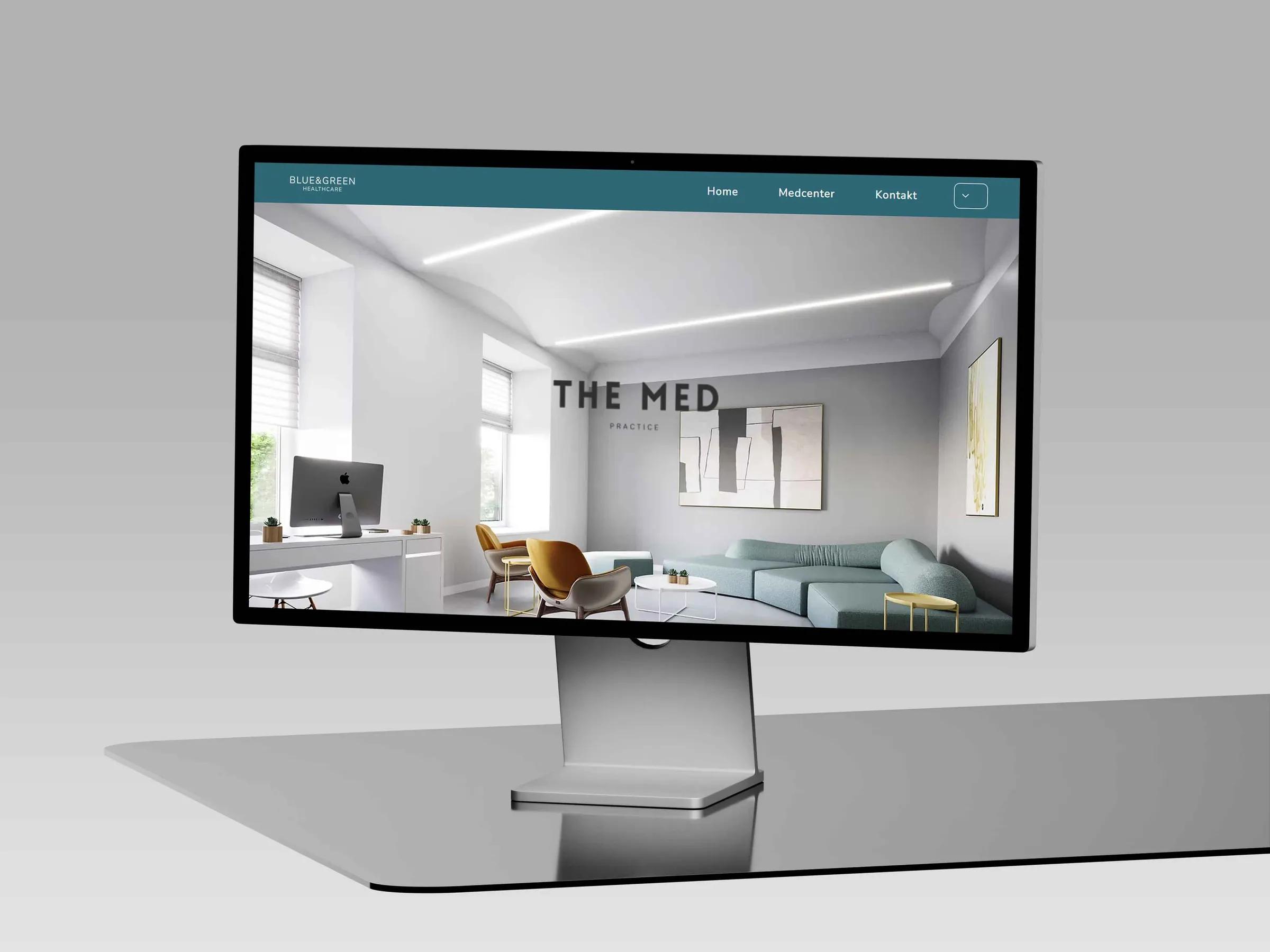
For specialists and medical companies the brief changes. For HBE Healthcare we built custom 3D animations that make medical processes from joint and cartilage down to the cellular level easy to see, and structured products such as PRP and hyaluronic acid so doctors find any piece of information in a few clicks. For Blue & Green Healthcare, which rents fully equipped practice rooms to doctors and therapists, we integrated Matterport 3D tours so prospects can walk through the locations from anywhere.
The price depends on scope: a single-doctor practice with five service pages is a different project from a group practice with several locations, online booking and multilingual content. We don’t work with standard packages. After a free strategy call you get a fixed quote, so you know exactly what you get. Typical market ranges in Austria are in our guide to website costs in Austria.
| Phase | What happens | Your time |
|---|---|---|
| Strategy & structure | Services, patient questions, keywords, sitemap | One workshop |
| Design | Look, photos, key pages | Feedback on drafts |
| Content & build | Texts in plain language, booking integration, SEO | Review and approve pages |
| Launch & local SEO | Google Business Profile, structured data, tracking with consent | Short handover |
After launch you edit texts, opening hours and holiday notices yourself in our CMS. Whether funding is available for your project we check in the strategy call (funding).
Not every practice needs a relaunch. If your practice is fully booked months ahead, you have no plans to change your patient mix and your site is correct, a careful update of your Google Business Profile and the imprint may be enough. The same applies if the site is less than two or three years old and technically sound: then better texts and local SEO usually bring more than a new design.
A new website is worth it when you want more private patients or a specific patient group, when you open a new location, when your phone line is constantly overloaded, or when the site doesn’t work properly on a phone.
In a free strategy call we look at your current site, your Google profile and your patient goals and tell you what is worth changing. Afterwards you get a fixed quote, with no surprises.
An imprint with name, address, contact details, Medical Chamber membership, professional title and the country that granted it, a reference to the Ärztegesetz and, if applicable, the VAT number, plus a privacy policy. For patients: services, insurance contracts, opening hours, directions and a clear way to book.
Yes, within limits. § 53 Ärztegesetz and the Medical Chamber’s guideline “Arzt und Öffentlichkeit” allow factual and true information. Pushy self-promotion, false exclusivity claims and advertising for medicines or medical devices are not allowed.
Yes. You need a data processing agreement with the booking provider, EU hosting, a privacy policy that names the provider and as few data fields as possible, because even the booking itself can count as health data under Art. 9 GDPR.
For aesthetic treatments and operations, no: the ÄsthOpG and the Medical Chamber treat before/after images as inadmissible advertising. For other areas, check with your regional Medical Chamber before publishing.
A typical practice website takes 8 to 12 weeks with us, from the first call to launch, and you see real progress every Friday. The timeline is confirmed in your fixed quote. More on our websites for doctors.
Through a complete Google Business Profile, consistent contact details everywhere, one page per core service with your location and structured data. For Christina Pedretscher regional landing pages strengthened the practice’s visibility in Carinthia.
More lessons from our projects in Vienna.
Websites • • 9 min read
 Patryk Wisniewski
SEO & GEO • • 8 min read
Patryk WisniewskiReal estate • • 8 min read
Patryk WisniewskiTell us about your project. Christoph gets back to you personally.
Christoph Speiser, Project lead & sales