Awwwards
404media is now part of Awwwards. Find our studio profile and work there.
(Announcement)
W.
404media is now part of Awwwards. Find our studio profile and work there.
We launched the new HBE Healthcare website.
We launched the new Property Partners website.
Portals bring buyers. Your own website has to bring sellers. What an Austrian agency site needs in 2026, from the Justimmo feed to the valuation form.
 Christoph SpeiserProject lead & sales
Short answer: a real estate agent website in Austria pays off when it does one job the portals can't: winning owners who want to sell or let. That takes three things: your broker software (usually Justimmo) feeding listings in automatically, a separate route for sellers with a valuation request, and pages fast and clear enough that Google and ChatGPT name your office. A typical build takes 8 to 12 weeks.
Most agency websites we see in Austria are digital business cards. They show the logo, the team photo and a property list that someone updates by hand twice a month. Buyers still find the listings on willhaben or ImmoScout24, and owners who want to sell compare five agencies side by side on the same portal.
We have built real estate sites for agents, developers and investment companies, including Hyatt Immobilien, Wolf & Sohn, LANDAA and Stoisser Immobilien Holding. This article is what we have learned about which parts actually bring enquiries and which are decoration.
Portals are where buyers and tenants search. That will not change, and you should stay there. But on the portal you are one listing among hundreds, next to your competitors, on terms the portal sets. The buyer remembers the flat, not the agent.
Your business, though, depends on mandates, and mandates come from owners. An owner who wants to sell a flat in the 19th district doesn't browse listings. They search for "Immobilienmakler Döbling", ask friends, or ask ChatGPT which agents are good. Whatever they find then decides whether you get the call. That is the job of your own website.
| Portal (willhaben, ImmoScout24) | Your own website | |
|---|---|---|
| Main audience | Buyers and tenants | Owners, plus buyers who already know you |
| Competition on the page | Every other agent in the area | None |
| Who owns the contact data | Shared with the portal | You |
| Shows your brand | Barely: a logo next to the listing | Fully: team, references, approach |
| Found for "agent + district" | Rarely | Yes, with local SEO |
| Follow-up (search alerts, saved lists) | Run by the portal | Run by you |
So the question is not portal or website. It is: what does your website do that the portal doesn't? If the answer is "show the same listings again", the site will not change much.
Most Austrian agencies manage their properties in broker software: Justimmo is very common here, along with onOffice, EDI-Real and others. The rule for the website is simple: you enter a property once, in the software, and it appears on the website without anyone copying anything.
Technically, there are three common ways to do this:
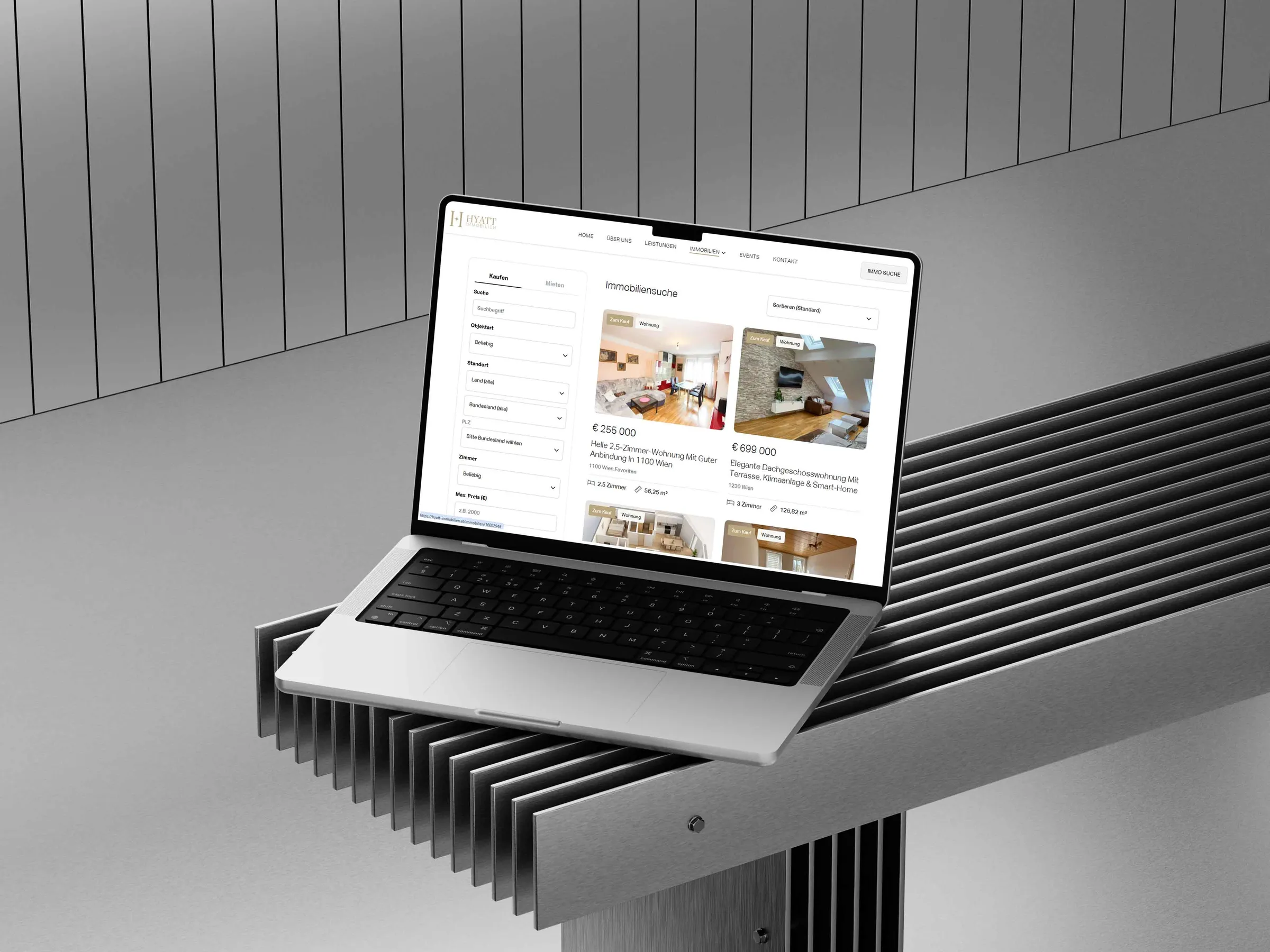
For Hyatt Immobilien the core task was to embed the Justimmo property search and detail views cleanly and design a modern layout around them, so the software feels like part of the brand. For Wolf & Sohn in Vienna we built a fully automated Justimmo interface for real-time data and added 3D renderings and virtual tours to the property pages. Wolfgang Sztatecsny from Wolf & Sohn put it this way: "Every integration, like Justimmo and other platforms, runs absolutely smoothly."
If you use EDI-Real or another system, check two things before the project starts: does the software have an API or an OpenImmo export, and does your licence include it? Some providers charge separately for interface access.
Buyers find you anyway, through portals. Sellers you have to win. That is why the most important page on an agent's website is usually not the home page but the seller page: a separate route for owners, with its own entry point in the menu and its own campaigns pointing at it.
What belongs on it:
One honest note on automatic online valuations: an instant price calculator generates many entries, but also many low-quality ones. We prefer a valuation request that leads to a personal assessment. Fewer leads, better conversations.
The property detail page is where buyers decide whether to enquire. It is also the page most often neglected, because it comes "out of the software". It is worth designing properly:
For Property Partners, which rents furnished apartments in Vienna, on the Semmering and in Wiener Neustadt, the whole site is built around a clear search (location, dates, guests) and well-structured detail pages that make the benefit of booking direct visible straight away.
Property sites are image-heavy: dozens of photos per listing, galleries, sometimes tours. Done badly, a listing page takes five seconds or more to load on a phone, and most visitors come from phones, often from a portal or an Instagram ad.
Google measures this with the Core Web Vitals. A page counts as good when the main content appears within 2.5 seconds (LCP), the page reacts to taps within 200 milliseconds (INP) and nothing jumps around while loading (CLS under 0.1). For property sites that mainly means modern image formats, images sized to the screen, and galleries that only load what is actually shown.
Iframe-embedded listing modules are a common speed and SEO problem: the content often isn't visible to Google as part of your site at all. With an API connection, every listing becomes a real page on your domain that can rank.
Owners search locally: "Immobilienmakler Wien 1090", "Wohnung verkaufen Graz", "Makler Mödling". For these searches three things count:
The last point is becoming more important. More and more people ask ChatGPT or Perplexity "which agent in Vienna is good for selling a flat?" and get three to five names. Whether your office is among them depends on how clearly your site and other sources describe you. We cover this in detail in how to get cited by ChatGPT, and you can check where you stand today with a free GEO report.
Many agency sites in a region look interchangeable: a header photo of a skyline, a search bar, three icons. Owners hiring an agent are choosing a person they trust with a large asset. The site should show who you are: the team, your approach, your area, sold properties.
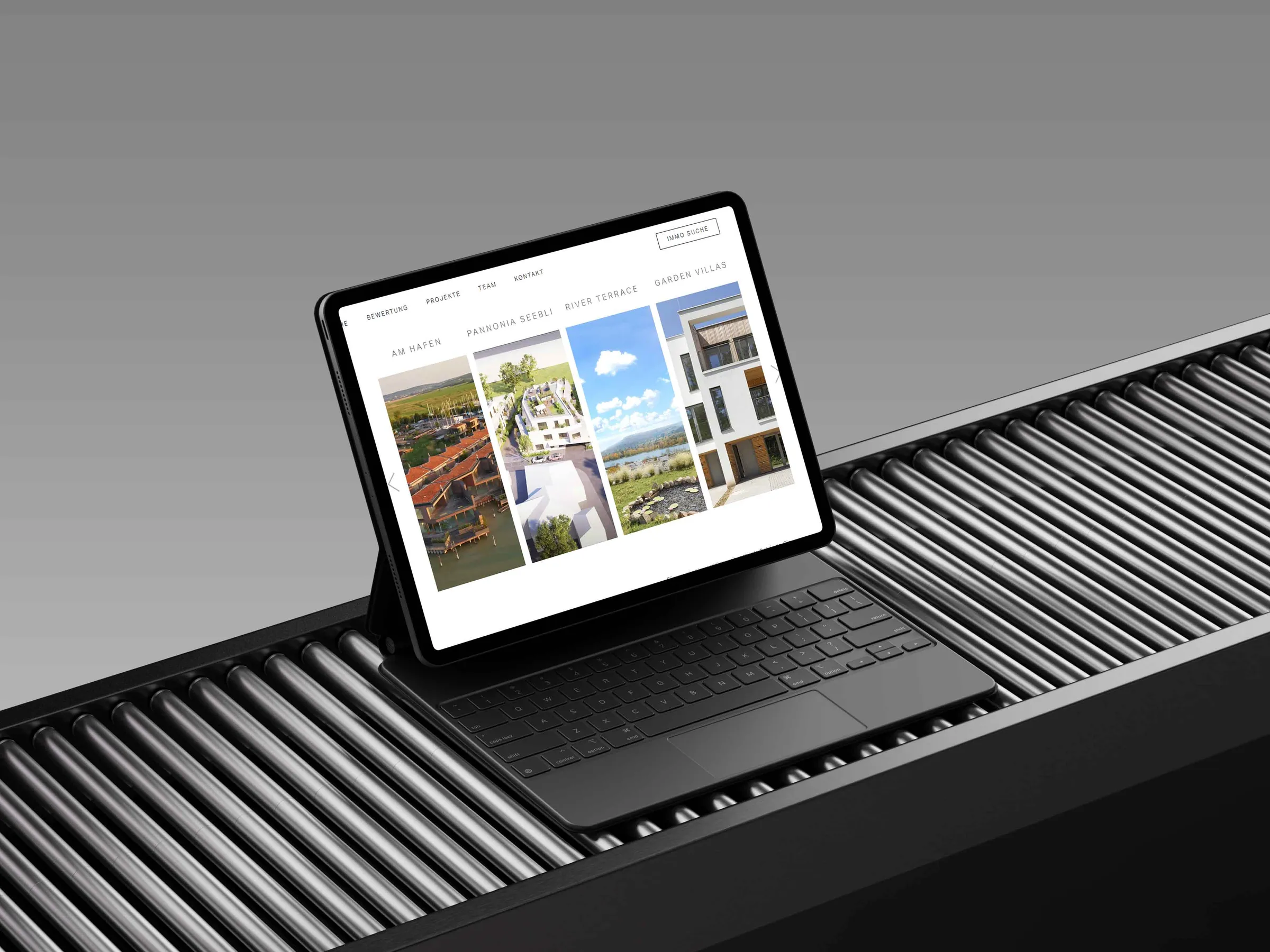
Different businesses need different sites. For Wolf & Sohn we developed the whole brand from scratch, from the logo to the interface. For Stoisser Immobilien Holding, an investor rather than an agent, the brief was the opposite: a strongly reduced digital business card that puts acquisition profiles and track record first, with no listing search at all. 16EAST needed a brand and portfolio site for acquisition, development and realisation.
It depends on scope more than on the number of pages. A digital business card with an embedded listing module is a different project from a site with an API connection, owner route, search alerts and location pages. These are the main cost drivers:
| Component | Effect on effort |
|---|---|
| Listing integration via iframe/module | Low, but limited design and weaker SEO |
| Listing integration via API (Justimmo, onOffice) | Medium to high, full control over search and detail pages |
| Seller route with valuation request and booking | Medium |
| Search alerts, saved lists, financing calculator | Medium |
| Location and district pages with real content | Depends on the number of areas |
| New brand (logo, colours, typography) | Separate block, often worth it for new or growing agencies |
| Photos, video, 360° tours | Per property or as a package |
We don't sell standard packages; you get a fixed quote after a free analysis. Ask about funding too: the federal digitalisation funding has ended, but regional programmes may fit; we check that in the strategy call. Status and alternatives: our funding article. For general price ranges, see what a website costs in Austria.
Not every agent needs a full build. Be honest with yourself:
And if the current site is basically fine, sometimes SEO, tracking and a proper seller page bring more than a complete relaunch.
In a free analysis we check your site, Google and ChatGPT visibility and enquiry routes, and show you where the mandates are being lost. See our work for real estate agents, or book a free strategy call and get a fixed quote.
Yes. Justimmo offers an API, and there is also OpenImmo export. At Hyatt Immobilien and Wolf & Sohn search, detail pages and listings run directly from Justimmo: you enter a property in the software and it appears on the website.
Usually yes. Portals bring buyers and tenants. Your own website is there to win owners, build your brand and keep the contact data with you. The two do different jobs.
A typical agent website takes 8 to 12 weeks from the first call to launch, and you see real progress every Friday. Brand development or extensive photography can add time.
With a separate route for owners: a short valuation request, figures for your districts, appointment booking without a phone call and references from sellers. Then point campaigns and local SEO at that page instead of the home page.
It depends on scope: listing integration, seller route, search alerts, location pages and branding are the main drivers. We give a fixed quote after a free analysis. The federal digitalisation funding has ended; regional programmes may fit, and we check that with you.
Only if consumers can conclude contracts online through the site, and micro-enterprises with fewer than 10 staff and up to €2 million turnover are exempt from the service obligations. A typical agent site with enquiry forms is usually not covered, but accessible design is still good practice. Details in our guide to the Accessibility Act.
More lessons from our projects in Vienna.
Real estate • • 8 min read
 Patryk Wisniewski
Real estate • • 10 min read
Christoph SpeiserWebsites • • 9 min read
Patryk WisniewskiTell us about your project. Christoph gets back to you personally.
Christoph Speiser, Project lead & sales